
A low monthly premium can be a poor deal if it leaves us paying for a serious crash ourselves. Cheap Car Insurance Quotes Online help us compare offers, but price alone cannot show whether a policy fits our needs.
A deductible is the amount we pay out of pocket toward a covered claim before our insurer pays. We should weigh the limits, deductible, and protections against our household’s risks, budget, and driving history.
Online comparison gives us a practical way to check prices and policy details from more than one insurer. We can look for a manageable premium without giving up protection we may need after a crash.
Key Takeaways
- Compare at least three offers with matching coverage.
- Use accurate driver, vehicle, and insurance details.
- Check limits, deductibles, exclusions, and effective dates.
- Ask about discounts, but keep needed protections in place.
- Review the insurer’s complaint record and claims support.
A useful comparison starts with the same protection in every quote, not simply the smallest number on the screen.
How Do Online Car Insurance Comparisons Work?
A driver can receive different prices from two insurers for the same basic profile, so checking more than one offer can reveal useful choices. Online quotes are free, and shoppers generally pay only when they choose to buy a policy.
Quotes online can come from an insurer’s own site, a comparison marketplace, or a licensed agent. The channel affects which insurance companies appear and which quote features we can compare.
An auto insurance quote is an estimate, not a promise of a final price. The insurer confirms the application details before issuing a policy, and the final premium may change.
Compare insurers directly or use a marketplace
Going directly to an insurer can show its own products and available options. A comparison site or marketplace may let us review offers from several companies in one place.
A licensed agent can help explain options and may represent one or more insurers. The insurers and quote features available through an agent or marketplace can differ from those on a company’s site.
Online car insurance shopping may feel simpler through one channel, but it does not always show every insurer. We can use a marketplace to narrow choices, then check details with the insurance company directly.
Keep coverage and policy terms alike
To compare quotes side side, we need the same liability limits, deductibles, optional protections, and policy term. Otherwise, a lower premium may simply reflect less coverage or a different payment schedule.
Compare at least 3 offers with matching limits and deductibles before treating the lowest premium as a genuine saving. Check that add-ons and policy terms match, too.
Compare at least 3 offers using the same limits, deductibles, and policy terms. A lower price is meaningful only when the protection also matches.
Keep a copy of each estimate and note the insurer, limits, deductible, and term. This makes differences easier to spot when the same driver receives very different offers.
What Information Do You Need for Personalized Quotes?
Having the household’s driver and vehicle details ready makes quote forms easier to complete accurately. Accurate details help insurers create personalized quotes that reflect the people and cars on the policy.
Use the same information on every form, since omissions or mismatched details can make a quote inaccurate or change the final premium. Gather these items before starting insurance shopping.
Driver and household details
Quote applications commonly ask for names, contact details, and information about other household drivers. Forms may also request age, ZIP code, and credit history.
- Driver names and dates of birth for everyone who may drive the car.
- Driver’s license details, including each license number and state.
- Recent tickets or accidents for each listed driver.
A household driver can affect the insurer’s estimate even if that person rarely uses the car. Leaving someone off a form may make the offer inaccurate.
Vehicle, location and insurance history
We should have the year, make, model, and vehicle identification number, or VIN, for every car. The VIN helps identify the exact vehicle rather than a similar model.
- Home address and the address where each vehicle is kept.
- Current or recent insurance details, including the insurer and coverage dates.
- Vehicle year, make, model, and VIN for each car.
Quote forms commonly ask for a phone number and may ask when current coverage began. We should answer each question as accurately as we can, rather than guessing to finish faster.
Before we submit, we can compare the entries across forms and fix any mismatch. Check every driver and vehicle before submitting, since a missing household driver can change the offer.
How Much Coverage Should You Choose?
Texas drivers must carry liability limits of 30/60/25, but the legal floor does not determine how much protection a household needs. State minimums may not cover all costs after a serious crash.
Liability coverage pays for injuries or property damage we cause to others. Optional coverage can help pay for injuries to us or damage to our own car.
Liability limits and state requirements
Texas is an at-fault state, and driving without car insurance is illegal. Its minimum liability limits are often written as 30/60/25:
| Coverage type | Texas minimum | Limit |
|---|---|---|
| Bodily injury per person | $30,000 | One injured person |
| Bodily injury per accident | $60,000 | All injured people |
| Property damage per accident | $25,000 | Other people’s property |
These limits set a legal floor, not a promise that every loss will be covered. We can choose higher limits when we want more protection against costs beyond the minimum.
Texas insurers must offer personal injury protection and uninsured/underinsured motorist coverage. Drivers may decline either in writing.
Protection for injuries and damage to your own car
Rules differ by state. Nearly all states require minimum liability coverage, while about half require uninsured/underinsured motorist coverage.
The 12 no-fault states are Florida, Hawaii, Kansas, Kentucky, Massachusetts, Michigan, Minnesota, New Jersey, New York, North Dakota, Pennsylvania, and Utah. Maine is the only state that requires medical payments coverage.
New Hampshire is the only state that does not mandate car insurance, but uninsured drivers must prove they can meet financial-responsibility requirements. Florida has a different rule: it requires property-damage liability and personal injury protection under its current requirements.
Florida is scheduled to become an at-fault state on January 1, 2027, with minimum bodily-injury and property-damage liability requirements or proof of financial responsibility as an alternative to buying insurance. Florida’s 2027 change affects which rules apply there.
Check the current rules in the state where the car is registered before choosing limits.
What Determines Your Car Insurance Rates?
A Texas full-coverage benchmark is about $204 per month, but a driver’s own quote can be higher or lower. That average equals about $2,448 per year and is only a reference point.
Actual insurance rates depend on the driver, vehicle, location, and selected coverage. A benchmark cannot predict what a particular household will pay.
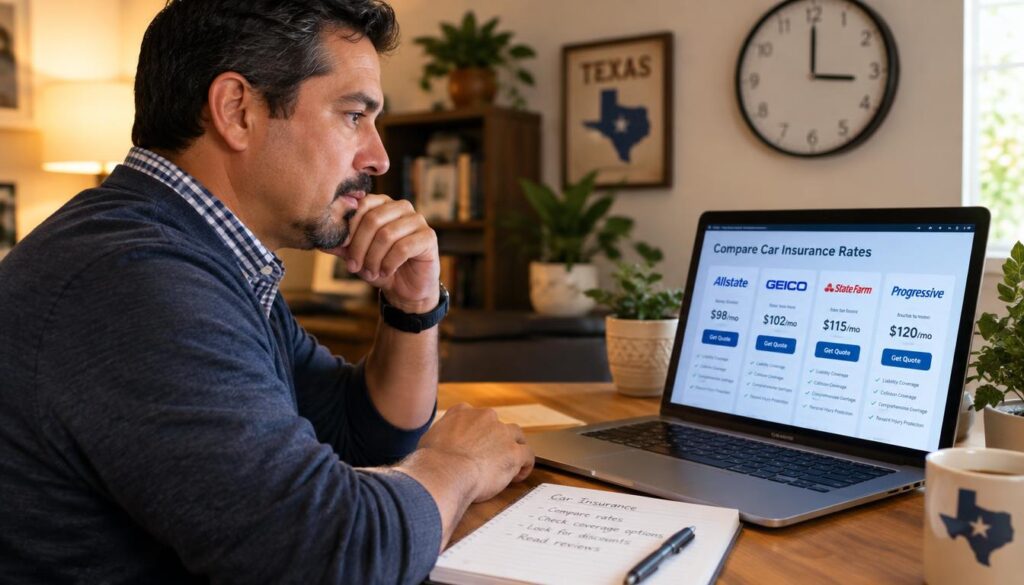
Location matters because insurers price risk by where a car is kept and driven. Rates can differ across cities and neighborhoods, even for drivers with similar records.
Age and driving history can also affect a price. Tickets or accidents may lead to higher offers, while a driver’s record and experience shape how insurers assess risk.
The car itself matters because repair costs, safety features, and the chance of theft can vary by vehicle. Selected limits and coverage also change the price: broader protection usually costs more than a basic policy.
When we search for cheap car insurance quotes online in Texas, we should compare the same protection from each insurer. One estimate with different limits or a different deductible is not a fair price check.
Insurers may weigh the same information differently, which helps explain why one driver can receive different offers. We can compare prices only after confirming that each quote covers the same risks.
Use an average as a reference point, then judge the quote against the same limits and deductible from other insurers.
What Are the Best Ways to Lower Your Premium?
The safest savings often come from checking eligible discounts and payment choices before reducing coverage. Discounts vary by insurer, and each company sets its own eligibility rules.
We can compare the total cost of home and auto policies, not just the discount label. The Oklahoma Insurance Department advises shoppers to compare insurers, ask about discounts, and weigh a higher deductible against its added out-of-pocket cost.
Discounts tied to driving and multiple policies
GEICO says insuring more than one car may qualify a policyholder for a multi-vehicle discount of up to 25%. Eligible customers who insure a vehicle with GEICO and a home through the GEICO Insurance Agency could save up to 25%.
GEICO also says defensive driving courses, clean driving records, and reported safety or anti-theft devices may lower rates. We should report installed devices so the insurer can check whether they qualify.
Bundling home insurance and auto coverage may reduce the combined price, but a discount does not always mean the total is lower. We can compare the combined offer with separate policies.
Choose a deductible and payment schedule you can manage
A higher deductible usually lowers the premium, but it also raises what we pay after a covered claim. We should choose an amount we can afford without draining money needed for other bills.
Paying a policy in full may qualify for a discount compared with installment payments. The Oklahoma Insurance Department’s consumer tips on lowering rates also advise checking whether a higher deductible fits our budget.
- Ask which discounts apply to our household and vehicles.
- Report safety and anti-theft devices to the insurer.
- Review the deductible and the amount we could pay after a claim.
- Compare the total cost of full and installment payments.
- Ask whether bundling auto and home policies lowers the combined price.
Choose a deductible only if you could comfortably pay it after a claim.
Which Cars May Cost Less to Insure in 2026?
Compact SUVs and smaller vehicles are often less expensive to insure than sports cars or luxury models. Nine vehicles may have lower insurance costs in 2026, but rates depend on driver, location, trim, and coverage.
Smaller vehicles often cost less to repair and may have strong safety performance. These broad traits can help explain price differences, but they do not set a guaranteed rate for any model.
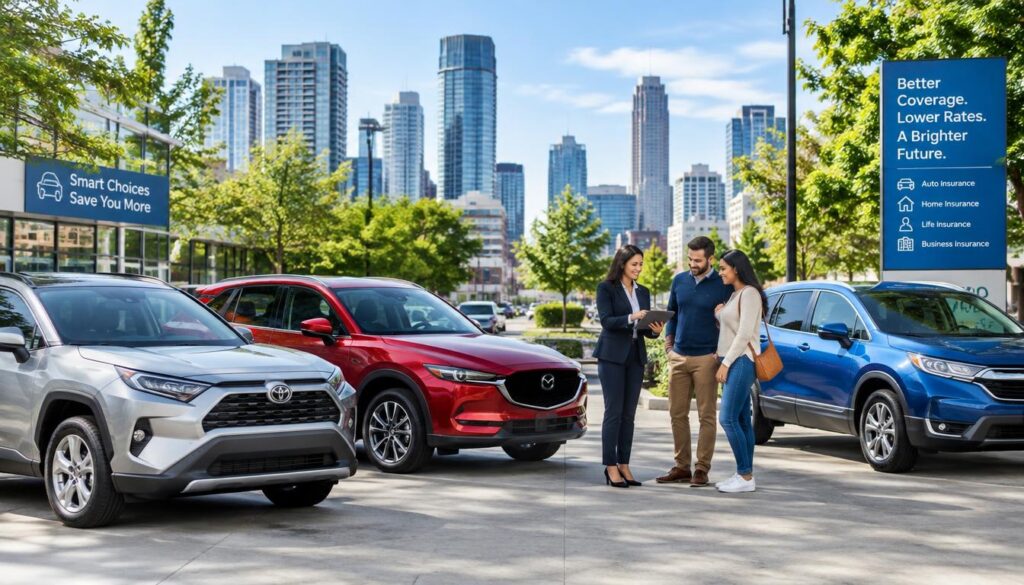
| Model | Vehicle type | Why it may be a lower-cost choice |
|---|---|---|
| Honda CR-V | Compact SUV | Compact vehicle with repair costs worth comparing |
| Subaru Forester | Compact SUV | Smaller size and safety performance may help |
| Subaru Outback | Wagon | Repair costs and safety can affect rates |
| Mazda CX-5 | Compact SUV | Parts and repair costs can shape insurance prices |
| Honda HR-V | Subcompact SUV | Smaller size may mean lower repair costs |
The remaining vehicles on the 2026 list are the Subaru Crosstrek, Hyundai Venue, Toyota Tacoma, and Ford Maverick. Their actual insurance rates still depend on the exact vehicle and policy.
Insurers may consider safety ratings, injury-claim risk, repair costs, and how easy it is to find replacement parts. Predictable repairs and widely available parts can help keep claim costs lower.
Higher-powered engines, sport packages, luxury interiors, and larger wheels can raise repair or replacement costs. Advanced sensor systems may also add expense when a damaged part needs service or replacement.
We can use these patterns to narrow a vehicle search, then check real offers for the trim we plan to drive. Compare quotes for the exact trim, since a model name alone cannot predict its premium.
How Can You Assess an Insurer Beyond Its Quote?
A low quote is only one part of a sound choice, so check how the insurer handles complaints and claims. Read full reviews and compare complaint records instead of relying on a star score.
Customer reviews can point out service issues, but one account cannot prove an insurer’s rates, coverage, or claims quality. We should read the full review and note its date and details.
Read customer reviews with context
A Trustpilot custom widget can display customer feedback, but it is not proof of policy terms or service quality. A “view full review” link may show more context than a short excerpt.
Search pages may use labels such as “full review Trustpilot,” “review Trustpilot,” or “view full.” Those labels do not replace checking policy details and complaint records.
Reviews can help us spot themes, such as repeated reports about billing or claim updates. We should consider the review date and the specific issue, rather than treating every comment as current.
Check complaints, claims support and financial strength
The National Association of Insurance Commissioners, or NAIC, provides a complaint index that compares complaints with an insurer’s market share. An index of 1.0 represents the expected complaint level for an insurer of its size.
We can also check the insurer’s financial-strength information and ask who handles claims and customer service. A company may use separate teams or outside partners for those tasks.
A comparison site or agent may receive compensation when we choose a policy. We can ask how the service makes money and which insurance companies it includes.
Look at complaint information alongside dated customer reviews, not as a replacement for reading the policy.
What Should You Check Before You Buy a Policy?
A minimum-liability policy can meet a legal requirement while leaving damage to your own vehicle uncovered. Liability coverage generally pays for harm to others, not repairs to our car.
Texas liability minimums do not include comprehensive or collision coverage. Those protections may matter when we want help paying for damage to our own vehicle.
Confirm what each coverage pays for
Liability, comprehensive, and collision coverage pay for different losses. The table shows the basic distinction:
| Coverage | What it may pay for | Protects policyholder’s car |
|---|---|---|
| Liability | Other people’s injuries or property damage | No |
| Comprehensive | Non-crash damage, such as hail, fire, or theft | Yes |
| Collision | Damage to the car from a car accident | Yes |
Liability-only coverage may meet a state’s legal minimum, but it does not cover damage to our own vehicle. Comprehensive may cover hail, fire, or theft, while collision covers damage from a car accident.
Check deductibles, exclusions and lender requirements
Lenders typically require comprehensive and collision coverage for leased or financed vehicles. We should check the loan or lease terms, since dropping required coverage could break that agreement.
Before we agree to buy, we should review the deductible for each coverage and read the exclusions. The deductible affects our share of a covered claim, while exclusions describe losses the policy does not cover.
We should also check limits, policy term, and the effective date. A quote may show a start date, but the insurer must accept the application and the policy must take effect.
Confirm the policy’s effective date and the deductible you would owe before accepting the offer.
How Do You Get Cheap Car Insurance Quotes Online and Complete a Purchase?
We can get an online estimate before deciding whether to buy, but coverage starts only after the insurer accepts the application and the policy takes effect. A quote alone does not activate coverage, and a no-deposit offer is not guaranteed.
The amount due before coverage begins depends on the insurer and policy. We should check the required first payment and its due date before relying on a start date.
A “very cheap car insurance with no deposit” offer may not be available for every driver or policy. If we want to buy auto insurance online instantly, we still need the insurer to accept the application and set an effective date.
- Choose the limits and deductible that fit our needs and budget.
- Gather accurate details for every driver and vehicle.
- Compare multiple offers with matching coverage and policy terms.
- Confirm the policy details, first payment, and effective date.
- Submit the application and make the first required payment.
Before sharing personal information, we should read the site’s privacy policy. It explains how the company handles details such as contact information and driver records.
For GEICO U.S. sales and service, call (800) 207-7847. Its emergency roadside service number is (800) 424-3426, which serves a different need.
A quote is an estimate, not active insurance. Confirm acceptance, the amount due, and the effective date before driving under a new policy.
Save the confirmation and insurance card, and make sure the new policy begins before canceling any existing coverage.
Conclusion
The most useful quote is the one that balances a manageable premium with protection we can rely on. A policy should fit our budget now and still provide suitable coverage after a covered loss.
The lowest price is not a saving if its limits leave us with costs we cannot manage. We should compare the same limits, deductible, and policy term across insurers.
Gather the details for every household driver and vehicle, then compare at least 3 matching offers before choosing a policy.