
A single customer injury, employee accident, or damaged tool can create a financial problem that a small company cannot easily absorb. Small Business Insurance Cost and Coverage choices help us plan for that risk without paying for protection we do not need.
Required coverage, daily operations, workforce, property, location, and contracts all shape the right options. A delivery van, a leased shop, and a home office face different risks, even when they belong to the same industry. The goal is to match protection to likely losses and the company’s budget.
Employee health benefits are separate from the commercial policies discussed here. We can use this guide to weigh common coverage, compare costs, and spot gaps before choosing a policy. Start by identifying the risks the business could not comfortably pay for itself.
Key Takeaways
- Start with losses the business could not pay on its own.
- Check state rules, licenses, leases, and client contracts.
- Compare premiums only when coverage and terms match.
- Review policies after major changes to work, staff, or property.
- Health benefits and commercial business coverage serve different needs.
Which Risks Can Business Insurance Cover?
A customer who slips in a shop, a client alleging faulty advice, and a stolen work van create three different kinds of claims. Different policies address those risks, and a business may need more than one.
A business owner’s policy bundles general liability, commercial property, and business income coverage. An aggregate limit is the maximum an insurer will pay for all covered claims during a policy period. A policy’s terms still decide which losses qualify.
A policy name does not prove that a particular loss is covered. Check the covered causes and exclusions.
General liability and a business owner’s policy
General liability can cover claims that the business caused bodily injury, property damage, or advertising injury to someone else. A customer’s medical bills after a fall may lead to a claim. So might damage to a client’s floor during a job.
A business owner’s policy, often called a BOP, combines general liability with commercial property and business income coverage. Business income coverage can help replace lost income when a covered property event temporarily stops operations. A BOP does not automatically cover every business risk, such as professional mistakes or every cyber loss.
Professional liability and cyber insurance
Professional liability, also called errors and omissions insurance, can help with claims that advice or services caused a client financial harm. A designer accused of missing a key deadline may face this kind of claim. The policy responds under its own terms, not simply because a client is unhappy.
Cyber insurance can help with certain costs after a data breach, ransomware event, or other covered cyber incident. Coverage may include help with response costs or claims tied to exposed data. Terms differ, so we should check what events and costs the policy names.
Commercial property and workers’ compensation
Commercial property coverage can protect tools, equipment, inventory, and supplies against covered events. A fire may damage stock, while a theft may remove equipment. The policy’s covered causes and exclusions determine whether it pays.
Business income coverage may help replace income during a covered shutdown, but it is not a promise to cover every lost sale. Workers’ compensation can help pay benefits when an employee suffers a work-related injury or illness. State rules and policy terms affect how that coverage works.
Commercial auto for work vehicles
Commercial auto can help cover bodily injury and property damage claims involving a business-owned vehicle used for work. A personal auto policy may not fit a vehicle used for business tasks. Cheap liability insurance for a car used for work means comparing commercial auto coverage, not assuming personal coverage applies.
Small-business commercial auto premiums averaged $245 per month in a 2026 cost guide. The actual price and coverage depend on the policy and business details. Check the policy’s covered causes and exclusions, since a policy name alone does not confirm that a particular loss is covered.
Which Insurance Does the Law or a Contract Require?
A company with employees or a work vehicle may face a coverage requirement before a client ever asks for proof of insurance. State and contract rules can make some policies or limits necessary.
Most states require workers’ compensation for businesses with employees, and almost every state requires commercial auto insurance for business-owned vehicles. Commercial auto minimum liability limits are state-specific. Industry rules, licenses, leases, and client agreements can add other conditions.
We can check four places before choosing optional protection:
- State workers’ compensation rules for the business and its employees.
- State commercial auto rules and minimum liability limits.
- License or industry requirements that apply to the work.
- Lease or client contract terms that require policies or limits.
A landlord may ask for proof of liability coverage before handing over shop keys. A client may require a certain limit before work begins. Those terms can affect which insurance policies we need, even when a law does not require them.
Rules can change and may depend on how a company operates. The relevant state insurance department or licensing authority can provide current details. Confirm the rule with the state authority before relying on a general description of requirements.
Small Business Insurance Cost and Coverage: What Does It Cost?
A useful starting point is about $45 per month for general liability, while a broader package can cost more depending on what it covers. A basic policy often suits a low-risk operation, while a BOP may fit a business with property to protect.
Published averages are benchmarks, not quotes. Customer datasets and cost models use different samples and business details, so their numbers should not be treated as interchangeable.
What is the most affordable small business insurance?
A basic general liability policy is often the most affordable starting option for a low-risk business. In one customer dataset with no stated data year, general liability averaged $45 per month. About 22% of small-business customers paid under $30 monthly, and 41% paid $30-$60.
Reported annual general liability premiums ranged from $265 to $3,030 in that dataset. Another 2026 model put the average at $123 monthly, or $1,474 annually, for a business with one to four employees. That model used $1 million per-occurrence and $2 million aggregate limits.
How do monthly averages compare across policies?
The figures below compare 2026 averages with customer averages whose data year is unspecified. Both columns show useful benchmarks, but neither predicts an individual company’s quote.
| Policy type | 2026 monthly average | Customer monthly average |
|---|---|---|
| General liability | $45 | $45 |
| BOP | $83 | $83 |
| Professional liability or E&O | $88 | $88 |
| Workers’ compensation | $54 | $54 |
| Cyber insurance | $129 | $129 |
Other 2026 monthly averages include $67 for commercial property, $245 for commercial auto, and $86 for commercial umbrella insurance. The 2026 BOP average was $83 monthly, or $990 annually, while another dataset also reported $83.
Customer averages with no stated data year include $108 for commercial property and $86 for commercial umbrella insurance. Reported monthly ranges were $45-$166 for general liability, $40-$141 for a BOP, $45-$76 for professional liability, and $60-$140 for commercial property.
The 2026 general liability model used 10 major providers across 408 industries, all 50 states, and Washington, D.C. It was updated August 17, 2026, and its state estimates used a benchmark business with one to four employees and $1 million per-occurrence and $2 million aggregate limits. One customer dataset reported $538 as an annual general liability figure. Compare the same coverage, limits, deductible, and business details before treating two premiums as comparable.
What Drives Small Business Insurance Costs?
A contractor and a home-based consultant can pay very different premiums even when both employ only a few people. The work itself, customer contact, and possible loss size help set the price.
In a 2026 model, construction and contracting general liability averaged $337 per month, 174% above the $123 all-industry benchmark. The benchmark covered a business with one to four employees and $1 million per-occurrence and $2 million aggregate limits.
How do industry and operations affect the premium?
A business with customers visiting its site faces different exposure from one that works from home. A coffee shop averaged $47 per month for general liability in one dataset with no stated data year. An IT consultant working from home averaged $32.
Those examples show how the kind of work can affect costs, but they are not direct quotes. Insurers may consider revenue, payroll, claims history, and class codes, which classify the work being insured. Property value and employee count also shape the amount of risk the policy covers.
| Business or location | Monthly general liability estimate | Relevant condition |
|---|---|---|
| All-industry benchmark | $123 | One to four employees, $1 million/$2 million limits |
| Construction and contracting | $337 | 174% above the benchmark |
| Coffee shop | $47 | Customer-facing setting |
| IT consultant working from home | $32 | Home-based consulting work |
| California | $190 | Highest state average in the 2026 model |
How do location and business size affect the premium?
Location changes the risks insurers price, including local claim patterns and operating conditions. The 2026 model estimated general liability at $190 monthly in California, its highest state average, and $87 in West Virginia, its lowest. It estimated $180 in New York and $184 in Washington, D.C.
Other reported state averages, with no stated data year, were $55 monthly in Florida, $54 in Colorado, $47 in Georgia and New Jersey, and $44 in New York. California, Pennsylvania, Virginia, and North Carolina each averaged $42 in that dataset. State figures from different datasets are not directly comparable.
Revenue and payroll can rise as a company grows, changing the amount of activity an insurer must cover. A larger staff may also mean more workplace exposure. Describe every service and worksite accurately, because an incorrect industry classification can lead to a premium adjustment or an uncovered claim.
How Much Coverage and What Limits Do You Need?
A common starting point for general liability is $1 million per occurrence and $2 million aggregate, but a contract or larger exposure may call for more. The likely claim size and the business’s agreements help us choose an amount.
Per-occurrence limits cap payment for one covered incident, while aggregate limits cap payment for all covered claims during the policy period. About 85% of general liability customers choose $1 million per occurrence and $2 million aggregate limits in a dataset with no stated data year. Another 8% choose $2 million per occurrence and $4 million aggregate limits.
A common limit is a starting point, not a rule for every company. A client contract may require more, and a business with higher potential losses may need more protection. Professional liability limits can also differ by industry and contract.
A deductible is the amount we pay out of pocket before eligible insurance coverage applies. It is different from a limit, which caps the insurer’s payment. The average selected general liability deductible was $500 in one dataset, while another reported range was $500-$1,000.
A higher deductible can lower the premium, but it also raises the amount due after a claim. A cash-strapped business may struggle to pay that share, even when the insurer accepts the claim. Set the deductible at an amount the business could pay promptly after a covered loss.
How Does Your Industry Change Your Coverage?
A handyman who repairs appliances faces a different mix of property-damage and injury risks from a consultant working at home. Each task can change the coverage a business needs and the premium it pays.
Cheap general liability insurance is useful only when it covers the actual work performed. Client property, tools, employee exposure, and contract terms can all affect the policy choice.
Cheap general liability insurance for a handyman
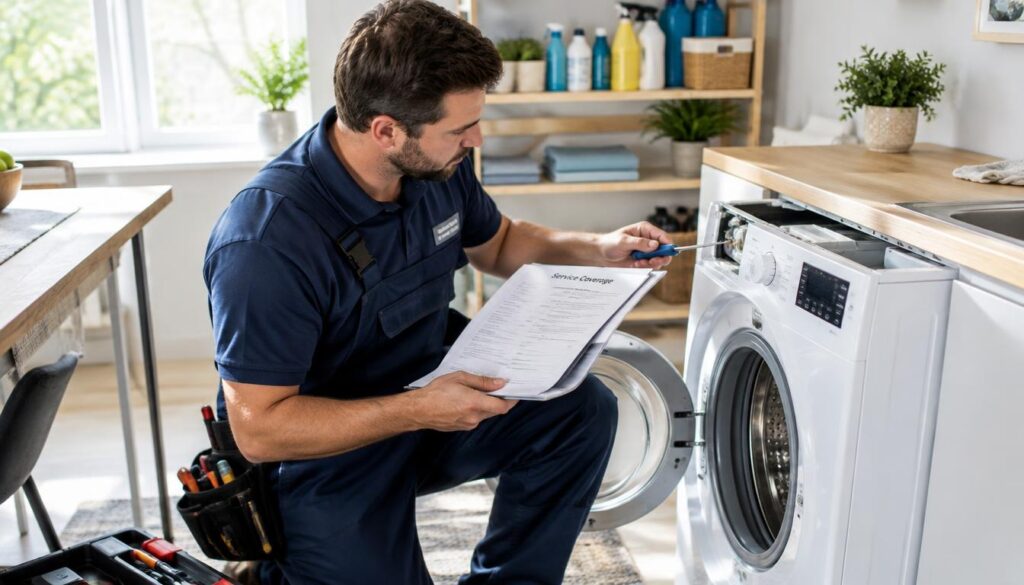
Cheap general liability insurance for a handyman should match the jobs performed, including installation, repair, and work at a client’s property. A low quote may leave a gap if the application lists repairs but the business also installs appliances.
Average annual handyman insurance costs were $810 for general liability, $1,687 for a BOP, and $1,032 for workers’ compensation in a dataset with no stated data year. Appliance contractors may pay $85-$90 monthly for general liability, depending on whether they install or repair appliances.
Those figures are benchmarks, not a promise for every handyman. The number of employees, job types, and property exposure can change a quote. We should check whether a policy covers damage to property while work is underway.
Cheap general liability insurance for contractors
Cheap general liability insurance for contractors is not just the quote with the lowest premium. Construction and contracting averaged $337 monthly in a 2026 model, 174% above its all-industry benchmark. The work can bring greater injury or property damage exposure.
Contractors should consider client requirements, tools, and employee exposure when choosing coverage. A client may require proof of insurance or a specific limit before a job starts. Workers’ compensation needs may also matter when a contractor has employees.
In 2024, U.S. private employers recorded 2.5 million nonfatal workplace injuries and illnesses. That figure makes employee exposure a practical concern, not a detail to skip on an application. List every task on the application, including occasional installation work, before accepting a contractor or handyman quote.
How Does Your Legal Structure Affect Insurance?
An LLC can separate many business liabilities from an owner’s personal assets, but it does not insure the company against claims. Entity protection and insurance serve different purposes.
An LLC’s liability shield is not absolute, so the business still needs coverage that fits its work. An owner should also keep business and personal finances separate and describe every work activity accurately.
Small business insurance for an LLC
Small business insurance for an LLC should reflect the legal entity doing the work and the risks it faces. An LLC can protect owners from personal liability in most instances, but not every one. Insurance can help the company handle covered claims the entity structure does not prevent.
Common LLC mistakes include treating the entity as a substitute for insurance, mixing personal and business finances, and leaving activities off an application. Those choices can weaken the separation between the owner and company or create questions when a claim arrives.
LLC members are self-employed and pay self-employment tax contributions toward Medicare and Social Security. That tax duty is separate from the company’s insurance needs. We should get qualified help with entity-specific tax questions.
Cheapest business insurance for a sole proprietorship
The cheapest business insurance for a sole proprietorship is not automatically the right choice. A sole proprietor’s business assets and liabilities are not separate from personal assets and liabilities, so the owner can be personally liable for business debts and obligations.
Choosing a low premium without enough protection can leave the owner facing costs the business could not pay. A limited partnership has one general partner with unlimited liability and other partners with limited liability. A limited liability partnership gives each owner limited liability and protects partners from partnership debts and other partners’ actions.
Cheapest business insurance for an LLC
The cheapest business insurance for an LLC depends on its operations and required policies, not the entity label alone. A home-based consultant and a contractor may need different coverage even if both formed LLCs.
Corporations provide the strongest personal liability protection among these structures, but they cost more to form than other structures. That distinction does not make a corporation a replacement for insurance. Legal structure and coverage solve different problems.
Match the policy to the work and confirm entity-specific legal and tax questions with a qualified professional.
How Can You Lower Premiums Without Leaving Gaps?
Three comparable quotes can reveal whether a lower premium comes from a real saving or from less protection. Same terms make it easier to judge whether a company is paying less for the same coverage.
A discount is useful only when the coverage and exclusions still fit the business. We can check five cost controls without trading away protection:
- Compare at least three quotes using the same limits, deductibles, and covered activities.
- Ask whether a BOP bundle fits the business; it combines three coverages when its terms work.
- Choose a deductible the company can afford to pay after a claim.
- Use loss-prevention steps that fit the work, such as securing tools and reducing injury risks.
- Ask whether annual payment or another discount is available.
A higher deductible may lower the premium, but it raises the amount paid out of pocket after a covered loss. That trade can be poor for a company with little cash in reserve. A BOP can also be a poor fit if its terms leave out a major business risk.
Insurance companies may offer discounts, but the savings matter only beside the policy wording. A cheaper plan can carry exclusions that remove protection for regular work. Reject a cheaper option if its exclusions remove protection for a routine part of the business.
How Should You Compare Insurance Quotes?
Two quotes are comparable only when they protect the same work, property, and potential claim amounts. Matching terms keeps a low headline premium from hiding a thinner policy.
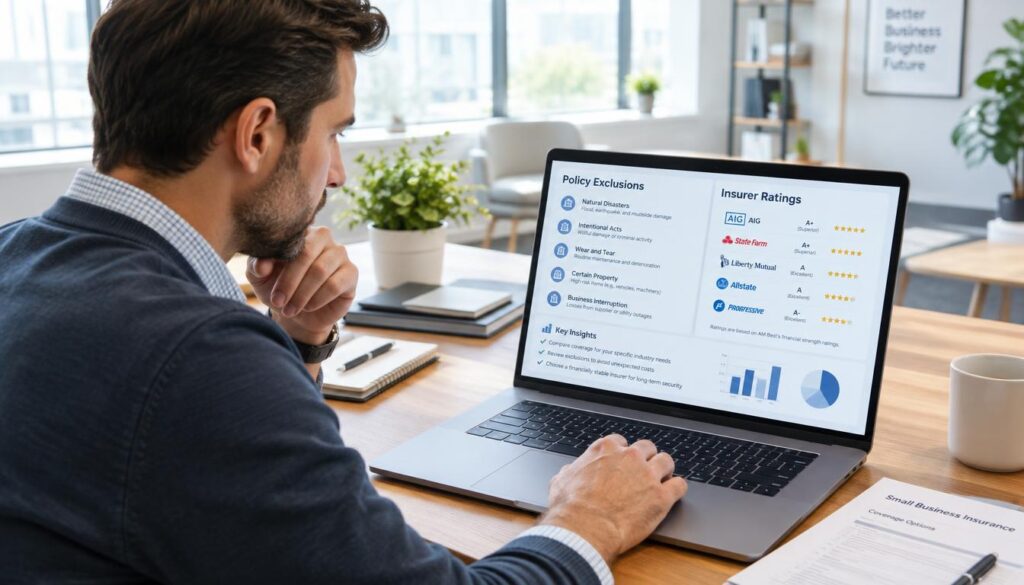
Compare limits, deductibles, exclusions, and policy terms across at least three quotes. We can also check four points before choosing an insurer:
- Licensing: verify an agent’s license with the state insurance department.
- Financial strength: review ratings from agencies such as AM Best or S&P Global.
- Claims service: ask how the insurer handles claims and communicates with customers.
- Policy fit: match limits, exclusions, and covered activities across each quote.
An independent broker can gather options from multiple insurers. An agent may represent an insurer. Either way, we should read the policy wording rather than judge the company from a price alone.
A common mistake is comparing headline premiums without checking exclusions or occurrence versus claims-made wording. An occurrence policy generally looks to when the covered event happened. A claims-made policy generally looks to when the claim is made, subject to its terms.
Keep the quote and policy wording together so the selected coverage can be checked against the original requirements.
What Mistakes Should You Avoid at Renewal?
A policy that fit last year’s payroll and services may not protect a business after it has expanded. Business changes can alter the risk the policy was meant to cover.
Many commercial policies run for a one-year term, so review the details at least once each year. A 20% change in revenue or payroll is a useful prompt to check whether coverage and pricing still fit.
At renewal, we should check four areas:
- Update revenue and payroll.
- Report new services or products.
- Add new locations and equipment.
- Confirm employee and vehicle changes.
New locations, equipment, employees, services, or products can change a company’s risk. A common mistake is assuming policies automatically adjust as the company grows. Some details may need a change to the policy or a new form of coverage.
A claims-made policy generally needs to remain active when a claim is filed. Tail coverage may extend the reporting period, often at added cost, after a policy ends. We should understand the reporting terms before changing insurers or ending a policy.
Review the declarations and exclusions at least once a year and whenever a material operation changes.
Should You Offer Health Benefits Alongside Business Coverage?
Health insurance serves employees’ medical needs, while commercial liability and property policies address risks to the business. They serve different purposes, so one does not replace the other.
In 2025, average employer-sponsored premiums were $9,325 for single coverage and $26,993 for family coverage. The worker’s share averaged $1,440 for single coverage and $6,850 for family coverage.
| Measure | Coverage level | 2025 annual average |
|---|---|---|
| Employer-sponsored premium | Single | $9,325 |
| Worker contribution | Single | $1,440 |
| Employer-sponsored premium | Family | $26,993 |
| Worker contribution | Family | $6,850 |
An employer may compare a group health plan with a health reimbursement arrangement, or HRA. An HRA lets an employer reimburse eligible health costs under set rules. The right plan depends on what the business can spend and what employees need.
Businesses with 50 or more full-time equivalent employees generally fall under the Affordable Care Act employer mandate. Full-time equivalent count combines employee hours to measure workforce size. We should check current IRS and HealthCare.gov guidance for eligibility and compliance.
Health benefits add a separate cost to the company’s budget. We can weigh the employer contribution against what workers may pay and the value of the plan. Check current federal requirements and the workforce’s budget before setting a health-benefit contribution.
Health benefits help pay for employees’ medical care. Commercial policies protect the business against covered operating risks.
Conclusion
Good coverage starts with an honest inventory of what the business owns, does, and could be held responsible for. A low premium has little value if the policy excludes essential work.
Our next step is to list activities, employees, vehicles, property, contracts, and desired limits. That record helps insurance companies price the same risks and makes gaps easier to spot before a claim.
Gather that inventory and request quotes using the same coverage limits and deductible.